You don't need technical skills in order to contribute here. Be bold when contributing and assume good faith when interacting with others. This is a wiki.
Hello @TaronjaSatsuma, I don't really understand the current table you created, so I did my own calculations, which you can see in the summary below. I am not completely sure that the calculations are correct, but you can see my analysis of the copyright laws in the collapsed section below.
Timeline of ROC copyright laws and the difference with the previous version
Copyright terms calculated from publish date (Article 30 to 35)
Copyright terms expires after 31 December of the final year (Article 35)
Changed copyright terms (per Article 30 to 34)
Individual: life+50
Publish between 40-50 years after individual's death: publish+10
Joint works: life of last author+50
Anonymous/pseudonym: publish+50
Legal entity: publish+50
Photos and films: publish+50
These copyright terms changes apply to:
All works created after 1985-07-10 (Article 107)
Registered works still within their copyright terms on 1992-06-10 under the copyright terms of 1985 text (Article 106)
Unregistered works published between 1965-07-10 and 1985-07-10 that still within their copyright terms on 1992-06-10 under the copyright terms of 1985 text (Article 106)
These copyright terms changes do not apply to (per Article 106):
Registered works that have entered PD under the copyright terms of 1985 text before 1992-06-10
Registered works that entered PD before 1985-07-10
Unregistered works published between 1965-07-10 and 1985-07-10 that entered PD under the copyright terms of 1985 text before 1992-06-10
Legal entity works: if unpublished within 50 years after creation, copyright expires 50 years after creation
This copyright terms changes applies and not applies to the same group of works mentioned in the 1992 section above (per Article 106)
2002-01-01 (WTO date)
Article 106-1 to 106-3 of the 1998 text begins implementing (Article 117)
1998 copyright terms now applies to works that have not "enjoyed copyright protection" by previous versions of the law (Article 106-1), these include unregistered works published before 1965-07-10
The main two reasons for registered work to be in PD in Taiwan on 2002-01-01 are:
Registered works that have entered PD under the copyright terms of 1985 text before 1992-06-10
Registered works that entered PD before 1985-07-10
and these works have to be published before 2002-01-01 (URAA date) to be PD in the US.
In summary, registered works that are PD in Taiwan and the US on 2002-01-01:
Registered individual works: author's death before 1962-06-10 and published before 2002-01-01
Registered joint works: last author's death before 1962-06-10 and published before 2002-01-01
Registered works by legal entities: works published before 1955-07-10, or works created before 1962-06-10 and published before 2002-01-01
Registered photos and films: works published before 1975-07-10, or works created before 1962-06-10 and published before 2002-01-01
Registered translations: works published before 1965-07-10, or works created before 1962-06-10 and published before 2002-01-01
The terms for registered photos here mostly matches with the terms in {{PD-ROC-oldphoto}}, so I am somewhat confident in my calculations. Also, apologies for the minimal formatting, I don't have much time to display this information in a clearer format. Let me know if you have any more questions. Thanks. Tvpuppy (talk) 01:07, 24 March 2026 (UTC)Reply
I modified the template, and ignored the support text. Still, I believe we should also look at art 14 of 1944 law and the "no heir" clause (which, on the other hand, I believe it's not going to be a very common one). Tell me your opinion about the current proposal of template.--TaronjaSatsuma (talk) 23:09, 27 March 2026 (UTC)Reply
It is not a "no heir" clause, article 14 of 1944 law states "著作權之移轉及繼承,非經註冊,不得對抗第三人". This roughly translates to "the transfer and inheritance of copyright, if it hasn't been registered, then it cannot be used to oppose a third party".
Note that the law uses the term "對抗 (oppose)", which means that the copyright would still be valid (still exists), but it just couldn't be used by the transferee/heir to oppose (sue) any unknowing third parties.
Also note that this article also exists as Article 15 of 1928 law, Article 16 of the 1985 law and Article 75 of the 1992 law.
The article was finally removed in the 1998 law. Since the 1998 law applies to all works still in their copyright terms in 1998, this means the article will not apply to any of those works.
In terms of Commons and this template, the article is irrelevant, as it doesn't apply to any works that are copyrighted on the URAA date, and the cases it may apply, have already entered PD.
@TaronjaSatsuma Apologies I forgot to tell you. Yes, I think this current template should be fine to publish. We can always adjust the template in the future if needed. Thanks. Tvpuppy (talk) 10:38, 4 April 2026 (UTC)Reply
Latest comment: 2 months ago1 comment1 person in discussion
2024 Picture of the Year:Mundari man polishing the horns of one of his Watusi cows using a mixture of cow urine and ash as a ritualistic and protective practice in a temporary cattle camp in Terekeka, South Sudan.
Dear Wikimedian,
Wikimedia Commons is happy to announce that the 2025 Picture of the Year competition is now open. This year is the twentieth edition of the annual Wikimedia Commons photo competition, which recognizes exceptional contributions by users on Wikimedia Commons. Wikimedia users are invited to vote for their favourite images featured on Commons during the last year (2025) to produce a single Picture of the Year.
Hundreds of images that have been rated Featured Pictures by the international Wikimedia Commons community in the past year are all entered in this competition. These images include professional animal and plant shots, breathtaking panoramas and skylines, restorations of historical images, photographs portraying the world's best architecture, impressive human portraits, and so much more.
For your convenience, we have sorted the images into topical categories. Two rounds of voting will be held: In the first round, you may vote for as many images as you like. The top 30 overall and the top 5% of most popular images in each category will continue to the final. In the final round, you may vote for just five images to become the Picture of the Year.
Latest comment: 2 months ago1 comment1 person in discussion
Dear Wikimedian,
You are receiving this message because we noticed that you previously voted in the Picture of the Year contest. Wikimedia users are invited to vote for their favourite images featured on Commons during the last year (2025) to produce a single Picture of the Year.
Hundreds of images that have been rated Featured Pictures by the international Wikimedia Commons community in the past year were entered in this competition. These images include professional animal and plant shots, breathtaking panoramas and skylines, restorations of historical images, photographs portraying the world's best architecture, impressive human portraits, and so much more.
In this second and final round, you may vote for a maximum of five images. The image with the most votes will become the Picture of the Year 2025.
Latest comment: 1 month ago1 comment1 person in discussion
Hi everyone,
Wikimedia Commons is pleased to finally announce the winners of this year's Picture of the Year 2025 contest! We had some truly incredible finalists to choose from, but the community has spoken.
Here are your top three winning images:
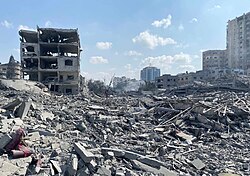
First place: The aftermath of an Israeli airstrike in Gaza City on October 9, 2023, leaving widespread destruction in the Rimal area. Attribution: WAFA (Q2915969) / CC-BY-SA 3.0
Second place: Baby cape fur seal (Arctocephalus pusillus) sleeping at Cape cross, Namibia. Attribution: Giles Laurent / CC-BY-SA 4.0
Third place: A gigantic jet photographed from the International Space Station by astronaut Nichole Ayers. Attribution: public domain
You can view the full results and see where all your favorite images placed here: Full 2025 Results
I also want to highlight what an incredible turnout we had. In the second round, we saw a massive jump in both the number of users voting and the total votes cast. We had exactly 13,979 votes cast by 3,509 users! To put that in perspective, last year we had 7,403 votes from 2,837 users. It is amazing to see that level of growth and community engagement.
Thank you to everyone who voted, helped organize, and generally made the contest such a huge success this year!
Hello @Trade, apologies but this is the first time I have heard about this property, so I don't really understand. Can you help me with my questions below?
Is this property only for certain NSFW files, and not for the regular files?
(I assume it is only for files relating to these 4 contents: "Sexual acts", "Sexualized nudity, erotica or ecchi", "Graphic violence, bodily mutilation or corpses" and "Medical or surgical gore")
Is this property optional for these NSFW files?
(I can't find where it said this property is a requirement)
You have mentioned in the Wikidata discussion that usage of this property can be discussed in "the Gadget talk page or have a dedicated project page". Which talk page is this?
You mentioned above that the warning template should "asks users to remember to tag their files", so is this property only meant for uploaders to add to their files? Can other users add this property to the files as well?
Latest comment: 26 days ago2 comments2 people in discussion
Just out of curiosity, have you considered getting Template editor right? This is not the first time I've seen you with templates. If you apply, I would be happy to support or maybe I can apply on your behalf, a kind of nomination. Shaan SenguptaTalk16:19, 29 May 2026 (UTC)Reply
Hello @Shaan Sengupta, thank you for your supportive message and offer.
I have only been doing template work occasionally (0.8% of total edits), and even less often for protected templates (I think I have requested 8 edit-requests for templates so far). At the moment, I don't think I need the right for my current workflow, and I don't think I am going to be more active in template work. So, I feel comfortable to just request an edit-request when I need it, hence I'm not currently planning to get this right.
Latest comment: 4 days ago2 comments2 people in discussion
Hello Tvpuppy,
because you wrote this, I managed to learn a really helpful way to use VFC that I was not aware of. I did think that I had to use RegEx manually, not that there was such a functionality built in. Thank you! Grand-Duc (talk) 19:38, 20 June 2026 (UTC)Reply


 First steps tutorial
 Getting help
 Goodies, tips, and tricks
 Made a mistake?




 Grand-Duc (talk) 19:38, 20 June 2026 (UTC)